
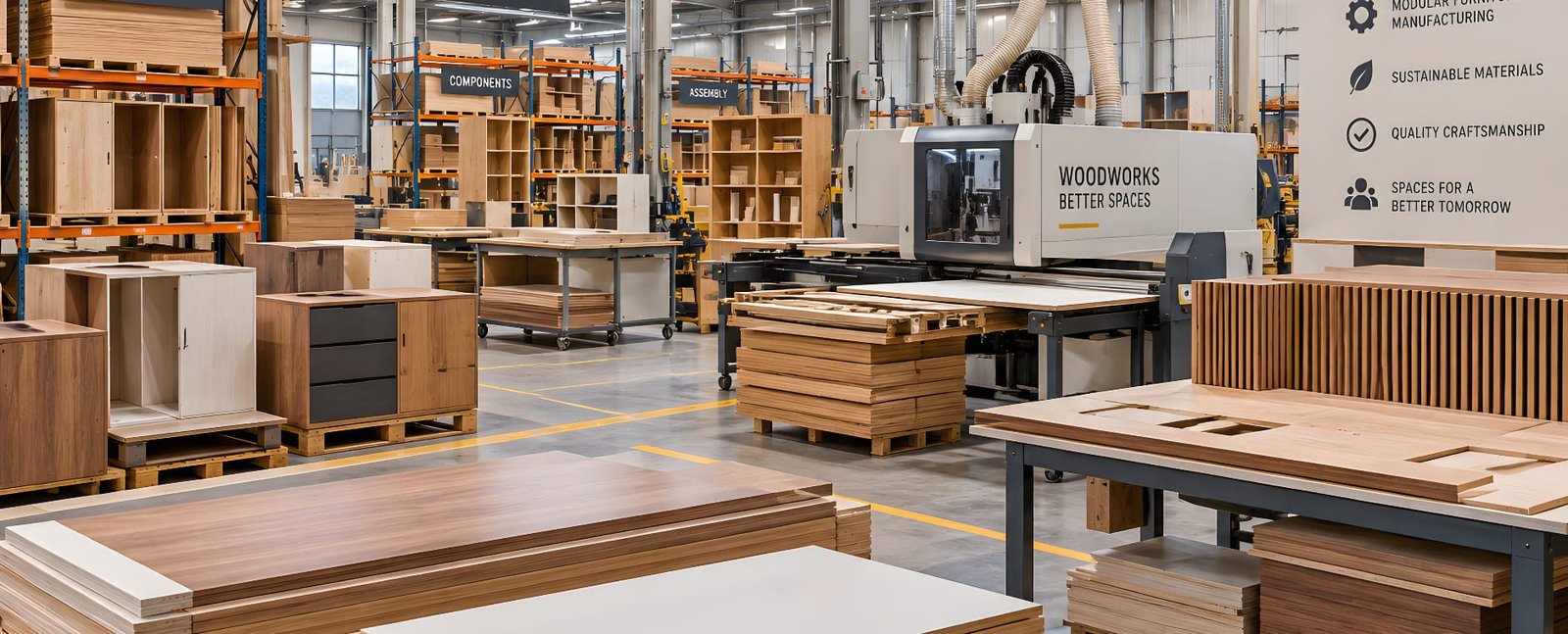
Factory-made interiors are interior components that are designed, manufactured and quality-checked in a factory before being delivered and installed at the project site.
This approach is commonly used for modular kitchens, wardrobes, storage units, wooden furniture, office interiors and other residential and commercial interior applications.
Key Takeaways
- Factory-made interiors are manufactured in a controlled production environment before installation.
- Modular components can be produced according to approved designs, dimensions, materials and specifications.
- Factory manufacturing can help improve production consistency and project coordination.
- Wooden modular interiors can be used across kitchens, wardrobes, homes, offices, retail spaces and other commercial environments.
- The process typically connects planning, design, manufacturing, quality checks and installation.
- Factory-made interiors can be suitable for both individual projects and projects involving multiple spaces or repeated components.
What Are Factory-Made Interiors?
Factory-made interiors are interior components manufactured away from the final project site in a dedicated production environment.
Instead of constructing every component from raw materials at the site, the interior is planned and manufactured as individual components or modules.
These components may include:
- Kitchen cabinets
- Wardrobes
- Storage cabinets
- TV units
- Display units
- Study units
- Office furniture
- Reception units
- Retail display units
- Counters
- Shelving
- Other wooden interior components
Once manufacturing and quality checks are completed, the components are prepared for delivery and installation at the project location.
The key difference is where and how the interior is produced: manufacturing takes place in a controlled factory environment, while installation takes place at the site.
How Does Factory-Made Interior Manufacturing Work?
A factory-made interior project generally moves through several connected stages.
1. Planning
The project requirements, spaces, measurements, intended use and overall scope are understood.
2. Design
Interior components are designed to suit the space, functionality, materials, finishes, and project requirements.
3. Finalisation
Dimensions, materials, finishes, hardware and other specifications are reviewed before production.
4. Manufacturing
The factory manufactures approved components according to the finalised specifications.
5. Quality Check
Manufactured components are checked before they are prepared for delivery.
6. Packing & Dispatch
Components are organised and prepared for transportation to the project site.
7. Installation
The manufactured components are assembled or installed at the site to create the finished interior.
This creates a connected journey: Plan → Design → Manufacture → Quality Check → Install
What Types of Interiors Can Be Factory-Made?
Factory manufacturing can be used for many different interior applications.
Residential Interiors
Factory-made wooden interiors can be used for:
- Modular Kitchens
- Wardrobes
- Full Home Interiors
- TV Units
- Pooja Units
- Study Units
- Crockery Units
- Foyer Units
- Storage Units
- Speciality Units
For homeowners, this approach can help bring different interior elements together through a coordinated design and manufacturing process.
Commercial Interiors
Factory-made interiors can also be used across business environments, including:
- Office Interiors
- Retail Stores
- Cafes
- Restaurants
- Co-working Spaces
- Institutional Spaces
- Showrooms
- Warehouse & Storage Areas
- Back-of-House Areas
Commercial projects may benefit particularly when multiple components or repeated elements need to be manufactured consistently.
Which Materials Are Used for Factory-Made Interiors?
Factory-made interiors can be produced using different wood-based and surface-finish materials depending on the application and specifications.
Common material categories can include:
Plywood
A layered wood-based panel commonly used in furniture and interior applications.
MDF
A manufactured wood panel often used for specific furniture and interior components, particularly where a smooth surface is required.
Particle Board
A wood-based panel made from compressed wood particles and commonly used in selected modular furniture applications.
Laminates
Surface materials available in a range of colours, textures and wood-inspired finishes.
Acrylic & Other Finishes
Depending on the design and application, different surface finishes can be incorporated into modular interior components.
The right material depends on factors such as application, expected use, design, budget, dimensions and finish requirements.
A good interior manufacturer should recommend materials based on the actual project rather than using the same material for every application.
What Are the Benefits of Factory-Made Interiors?
The main advantage of factory-made interiors is that manufacturing takes place in a more controlled production environment.
Consistent Manufacturing
When multiple components are produced through a defined manufacturing process, it becomes easier to maintain consistency across repeated elements.
Precision
Components can be manufactured according to approved drawings, measurements and specifications.
Better Production Control
A factory-based process allows manufacturing activities to be organised before components reach the site.
Quality Checks
Components can be checked during or after production before installation.
Better Project Coordination
When design, manufacturing and installation are connected, project requirements can be coordinated across different stages.
Suitable for Repeated Components
Factory manufacturing can be especially useful when a project requires multiple similar kitchens, wardrobes, storage units, workstations or other components.
Cleaner Site Execution
Since significant component production takes place before reaching the site, the site work can focus more on assembly and installation rather than producing every element from scratch.
Are Factory-Made Interiors Customisable?
Yes. Factory-made interiors can be customised around the project. Customisation can include:
- Dimensions
- Storage requirements
- Layout
- Materials
- Colours
- Finishes
- Internal configurations
- Hardware
- Functional requirements
- Design style
For example, two kitchens may both be factory-made but have completely different layouts, storage configurations, finishes and dimensions.
The factory provides the manufacturing environment; the design still needs to be developed around the individual project.
How Does Factory Manufacturing Help Large Projects?
Factory manufacturing can become particularly useful when a project involves multiple spaces or repeated interior elements. Consider a residential development with several homes requiring similar kitchens and wardrobes.
Instead of treating every unit as a completely separate site fabrication exercise, components can be planned and manufactured through a coordinated production process.
The same principle can apply to:
- Apartment projects
- Multi-unit residential developments
- Office rollouts
- Retail chains
- Co-working spaces
- Institutional projects
- Multiple business locations
This can help create greater consistency across the project while making production easier to coordinate.
What Should You Look for in an Interior Manufacturer?
Choosing an interior manufacturer is not only about looking at finished photographs. Before starting a project, consider:
Does the manufacturer have a clear process?
Understand how the company handles planning, design, manufacturing, quality checks and installation.
Can they manufacture according to your requirements?
Ask whether the manufacturer can work with your dimensions, designs, materials and specifications.
How is quality checked?
Understand when and how components are inspected.
Can they handle your project type?
Residential homes, multi-unit developments, offices and retail projects can have very different requirements.
Can manufacturing and installation be coordinated?
A good manufacturing process still needs proper site execution.
Can they support repeated components?
This becomes important for builders, developers and businesses working across multiple spaces.
Can they work with architects and designers?
For professional projects, collaboration with the existing design and project team can be important.
Factory-Made Interiors for Homeowners
For homeowners, factory-made interiors can provide a structured way to create modular elements across different rooms. A complete home project may include:
- Modular Kitchen
- Wardrobes
- TV Units
- Study Units
- Pooja Units
- Crockery Units
- Foyer Storage
- Speciality Units
- Other Storage Solutions
Instead of treating each room as an unrelated project, these elements can be planned around a common design direction.
Factory-Made Interiors for Businesses
Businesses often have different priorities from homeowners. An office, restaurant, retail store or commercial facility needs interiors that support both appearance and everyday operations.
Factory-made solutions can be developed for:
- Workstations
- Reception Areas
- Storage
- Display Units
- Counters
- Shelving
- Meeting Rooms
- Back-of-House Areas
- Utility Storage
- Other commercial interior components
For businesses with multiple locations or repeated formats, manufacturing can also help maintain consistency between spaces.
Factory-Made Interiors for Builders and Developers
Builders and developers may have requirements involving multiple homes, units or project phases. A factory-led manufacturing approach can support these requirements through:
- Standardised components
- Repeated production
- Coordinated manufacturing
- Project-level planning
- Quality checks
- Installation coordination
This makes factory-led manufacturing particularly relevant to projects where consistency, repeatability and coordination are important. For builders, the goal is not simply to manufacture furniture. It is to create a more organised interior delivery process.
Does Factory-Made Mean Mass-Produced?
Not necessarily. Factory manufacturing describes where and how the components are produced. It does not automatically mean that every project has the same design.
Factory-made interiors can be:
- Custom-designed
- Dimension-specific
- Material-specific
- Finish-specific
- Project-specific
- Function-specific
A custom home and a multi-unit development can both use factory manufacturing while having very different design requirements.
Is Factory-Made Interior Manufacturing Suitable for Every Project?
Not every project needs the same manufacturing approach. The suitability of factory-made interiors depends on factors such as:
- Project size
- Number of components
- Design complexity
- Site conditions
- Required customisation
- Project timeline
- Material requirements
- Installation requirements
- Number of locations or units
For smaller or highly site-dependent requirements, a different execution approach may sometimes be appropriate. The important consideration is to select a manufacturing and installation process that matches the project.
Why Does the Factory Matter in Interior Design?
Design determines how an interior should look and function. Manufacturing determines how that design becomes a physical component.
When design and manufacturing are closely connected, decisions about dimensions, materials, construction and finishes can be considered before production begins.
That is why the factory can play an important role in creating more coordinated interiors.
Scala Modular & Interiors, this approach brings together planning, design, wooden interior manufacturing and installation under one connected process.
How Scala Approaches Factory-Made Interiors?
Scala Modular & Interiors is built around a factory-led approach to residential and commercial interiors. The process connects:
Planning → Design → Manufacturing → Quality Check → Installation
Our solutions can include modular kitchens, wardrobes, full home interiors, speciality units and commercial interior components. For builders, architects and businesses, the same manufacturing approach can support projects involving multiple spaces, repeated components and different commercial environments.
The objective is straightforward: Make the interior process more coordinated from factory to finished space.
Frequently Asked Questions
What are factory-made interiors?
Factory-made interiors are interior components designed and manufactured in a factory before being transported to the project site for installation. They can include modular kitchens, wardrobes, storage units, office furniture and other wooden interior components.
Are factory-made interiors customisable?
Yes. Factory-made interiors can be customised according to the project’s dimensions, layout, materials, finishes, storage requirements and functional needs.
What is the difference between factory-made and site-made interiors?
Factory-made interiors are manufactured in a controlled factory environment and then installed at the site. Site-made interiors are fabricated or constructed largely at the project location.
Are factory-made interiors suitable for homes?
Yes. Factory-made interiors are commonly suitable for residential applications such as modular kitchens, wardrobes, TV units, storage and full-home interiors.
Can factories manufacture commercial interiors?
Yes. Factory manufacturing can be used for office, retail, F&B, co-working, institutional and other commercial interior components.
What materials are used for factory-made wooden interiors?
Depending on the application, materials can include plywood, MDF, particle board and different surface finishes such as laminates. Material selection should be based on the project’s use, specifications and requirements.
Are factory-made interiors good for builders?
Factory-led manufacturing can be useful for builders and developers, particularly when projects involve multiple units or repeated interior components that need consistent production.
Can architects work with an interior manufacturer?
Yes. Architects and interior designers can work with manufacturers to translate approved designs and specifications into manufactured interior components.
Does factory-made mean standardised design?
No. Factory-made interiors can still be customised. The manufacturing process can produce components according to project-specific dimensions, materials, finishes and designs.
How long does a factory-made interior project take?
The timeline depends on the project’s size, scope, design finalisation, manufacturing requirements, materials, quantities and installation conditions. A project-specific timeline should be established during planning.
Conclusion: Why Factory-Made Interiors Are Becoming an Important Approach?
Factory-made interiors bring manufacturing into the interior design process.
Instead of producing every component directly at the project site, interiors can be planned, designed and manufactured in a controlled environment before installation.
This can provide benefits such as production consistency, precision, quality checks, better coordination and scalability, particularly for projects involving multiple components or repeated spaces.
For homeowners, it can provide a structured approach to modular interiors.
For businesses, it can support functional commercial environments.
For builders, developers and architects, it can provide a manufacturing partner for projects that require coordinated production.
Ultimately, the value of factory-made interiors is not simply the factory itself. It is the connection between design, manufacturing and installation.
Planning a Residential or Commercial Interior Project?
Whether you’re planning a home, developing multiple residential units, building an office, or creating a commercial space, Scala Modular & Interiors brings together planning, wooden interior manufacturing, and installation in one factory-led process.
Designed with Purpose. Manufactured with Precision. Installed for Your Space.